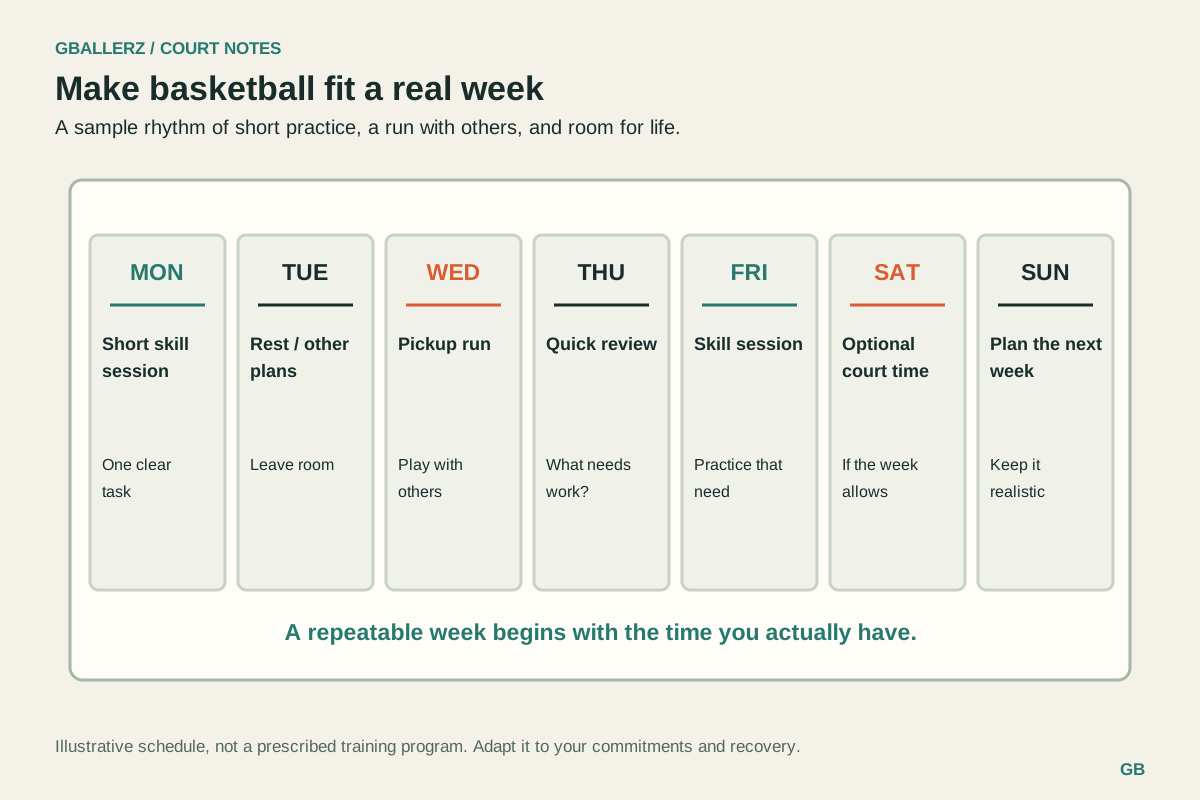
A basketball routine needs to fit the week you actually have. A plan that depends on several free evenings, a quiet court and perfect attendance may disappear as soon as work or family commitments change. Begin with one realistic anchor session and one smaller alternative. Decide what each session is for so that limited court time does not become a rushed attempt to practice everything.
Find the reliable opening
Look at your usual week and identify a time that is often available, including travel and getting ready. A forty-minute court window is different from forty free minutes at home when the court is fifteen minutes away. Choose the location and check its access hours or booking requirements. Put the session in your calendar with a realistic ending time. You can add another day later, but one appointment that you can keep is a more useful foundation than an ambitious schedule that repeatedly conflicts with ordinary responsibilities.
Give the session one main purpose
Pick a focus such as weak-hand handling, close shooting or playing a regular pickup game. A practice session might include a short preparation, a focused block and a few game-like repetitions. Keep the task specific enough to begin without planning at the court. Write down the starting spot, number of attempts and one observation to record. A social run has a different purpose: you may choose to work on communication or spacing during the game rather than treating every possession as a private shooting drill.
Create a genuinely smaller fallback
Decide what you will do if the main window shrinks or the court is unavailable. The alternative might be a short permitted ball-handling session in a clear area, a few wall passes where appropriate or reviewing a previous practice clip and planning the next task. It should fit the available setting without disturbing neighbors or creating obstacles. A fallback does not need to reproduce the full session. Its value is keeping the next action obvious when the original plan no longer fits the day.
Leave room for other people
If the routine involves a partner or regular run, confirm the time and communicate changes early. Have a solo option so one cancellation does not erase the whole plan. Respect family, work and shared-space commitments when choosing the schedule. A routine that repeatedly makes someone else wait is less likely to last. When the week is unusually busy, deliberately shorten or skip a session rather than trying to recover every missed minute in one exhausting visit. The calendar should support the habit, not become a score you must defend.
Restart with the next normal session
After a missed week, return to the simplest planned task and review your notes. You do not need a special punishment workout or a completely new schedule. If the same conflict keeps recurring, change the time or location. Treat repeated obstacles as information about the plan.
Schedule one realistic basketball window, write one smaller fallback and choose a specific first task so returning after a missed session requires little extra planning.
Something unclear? Send a correction or question.