A public court can contain overlapping basketball, volleyball and other markings. Even basketball lines may represent more than one competition. Before a game begins, identify the hoop you are using, the correct boundary and the arc everyone agrees to recognize. A minute of orientation prevents several avoidable interruptions later.
Find the rectangle first
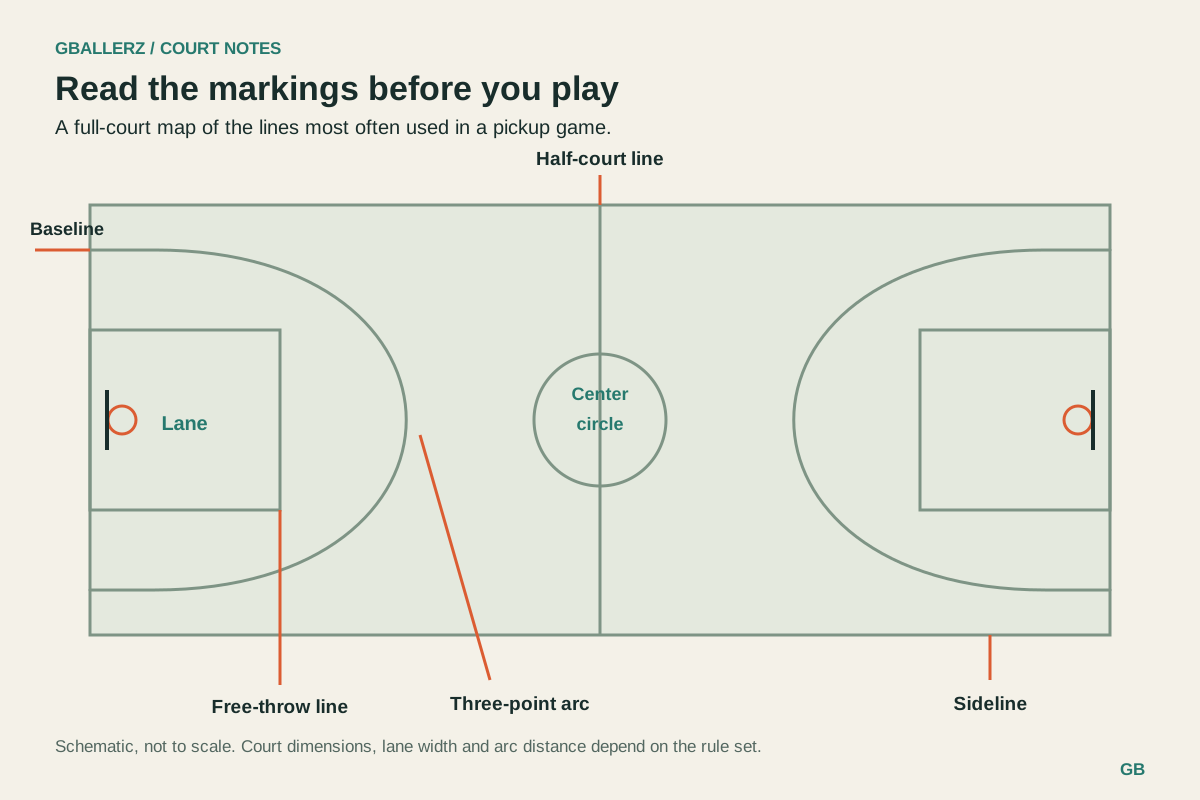
The sidelines run along the length of the playing area, while the endlines sit behind the baskets. In NBA rules, the boundary line itself is out of bounds; touching it is not a way to remain safely in play. Other organized competitions also define their boundaries in their own rulebooks.
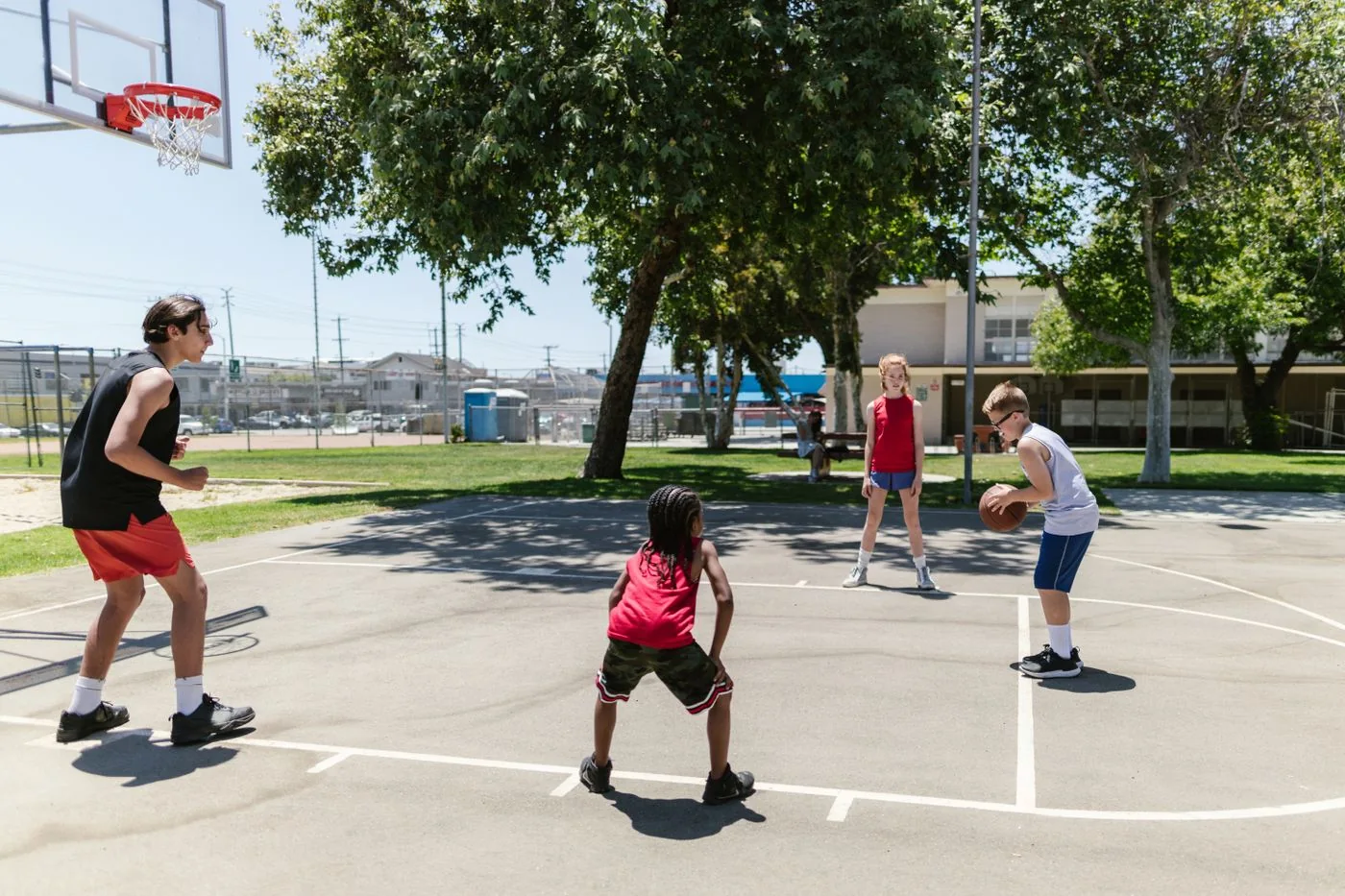
At an outdoor court with worn paint, walk the intended edge together. Do not quietly substitute a fence, curb or patch of asphalt as the line halfway through a possession. Keep spectators and spare equipment beyond the playing boundary with room for players to slow down.
Locate the lane and free-throw line
The painted rectangle beneath the basket is commonly called the lane or key. Players also use its edges as landmarks for positioning, cuts and rebounds. The free-throw line marks the shooting location for free throws under the applicable game rules.
For communication, the elbows are the upper corners of that lane area near the free-throw line. The blocks refer to lower lane positions near the basket. Those names help teammates describe a spot without pointing during a live possession. They are landmarks, rather than separate positions everyone must occupy.
Choose the right arc
The curved three-point marking is not the same distance in every competition. A shared gym may show several arcs, so confirm which one applies. In a casual game using ones and twos, the group may choose one painted arc for the higher-value shot.
Do not assume a long shot counts for more just because it felt far away. Learn where the arc reaches the sideline, and make your feet easy to judge. When markings are missing, agree on a clear substitute before play or use one value for every basket.
Use the middle of the court as a reference
The center line divides the full court. The center circle is familiar from the opening jump ball, but its presence does not mean every local game uses a jump-ball start. In half-court pickup, the group may start with a check outside the arc instead.
References such as top, wing and corner describe areas relative to the basket. The top is above the lane, wings are to either side, and corners sit near the meeting of sideline and endline. These words are more useful when everyone knows which basket the speaker means.
Do a quick court walk
Start at one endline and trace the boundary, then identify the lane, free-throw line and chosen arc. If another sport's paint crosses your route, note the basketball color before starting. Check that both teams have the same understanding.
Use the right court specification
Court dimensions and markings are competition-specific. Use the organizer's diagram for a league game instead of measuring a neighborhood court against a professional layout. For pickup, a clearly agreed playing area is more useful than an unresolved debate about which league the paint resembles.
Identify the boundary and agreed scoring arc first, then use lane landmarks to communicate clearly during play.
Further reference
Something unclear? Send a correction or question.