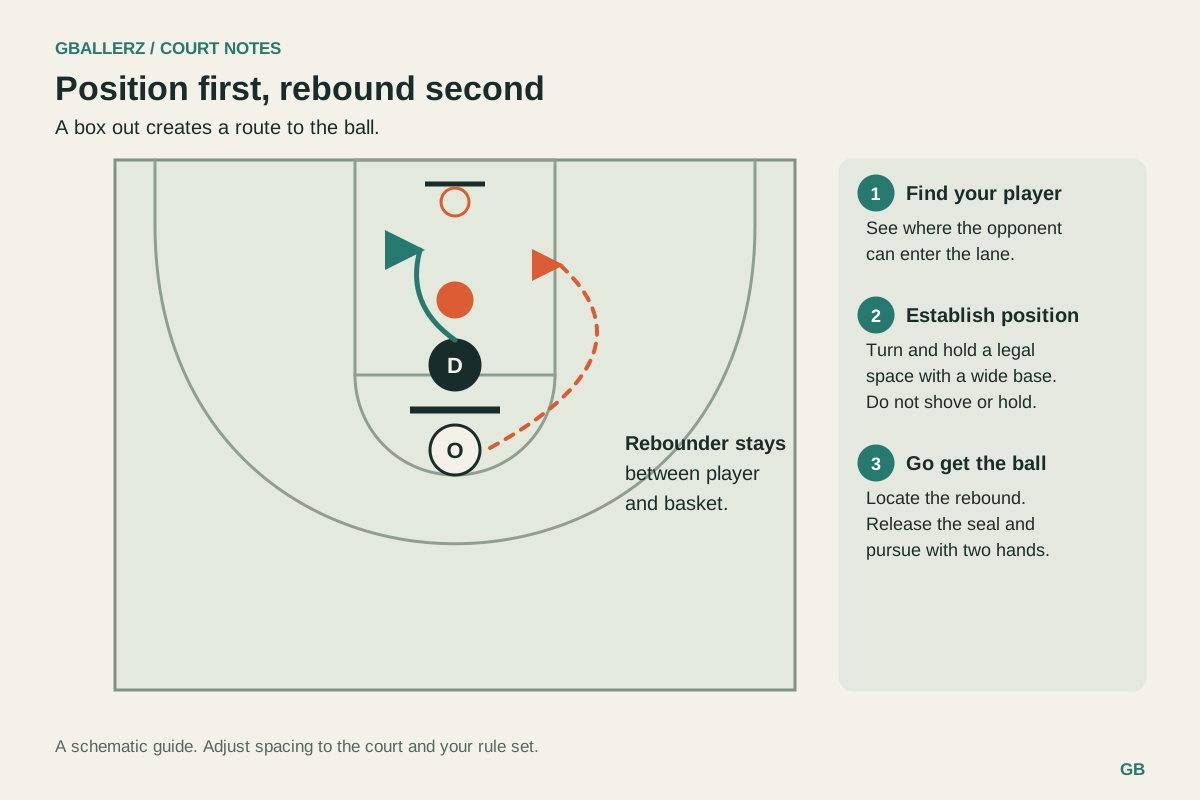
Rebounding starts before the ball reaches the rim. If you stare at the flight and immediately run toward the basket, an opponent may move past you into the best space. Boxing out is the effort to establish position between that opponent and the rebound, within the contact rules of your game. Practice it with controlled partners and light pressure, focusing on awareness and position rather than forceful collisions.
Locate the person as the shot goes up
Begin with a partner a few steps from the basket and another player taking easy shots. As the shooter begins, check where your opponent is before following the ball. Keep enough awareness of the flight to react, but do not let it erase the person moving beside you. Start with the opponent walking toward the rim. The aim is to recognize their route early. If you discover them only after they are in front of you, slow the drill and practice the first look again.
Get into the space without holding
Move into a balanced position between the opponent and the likely rebound area. Use your feet to claim that position instead of wrapping an arm around them, pushing backward or grabbing clothing. Contact rules and enforcement differ, so ask a coach or official to clarify the positioning allowed in your game. In early practice, the partner can simply stop when you establish the route. That teaches the spatial idea without turning the exercise into a contest of strength.
Release toward the ball
Once you have established position, locate the rebound and move to it. Do not remain fixed against the opponent while the ball falls elsewhere. A long miss may travel far beyond the area under the hoop. Practice with the shooter alternating nearby and more distant attempts so you must read different rebounds. Keep a controlled landing space and avoid leaping backward into another player. Secure the ball before preparing an outlet, rather than reaching for a dramatic one-handed touch when two hands are available.
Use a low-pressure scoring task
Give the defender a point for locating the opponent and establishing a useful position, then another for securing the rebound. Give the opponent a point for reaching a clear path without pushing or grabbing. Stop immediately if contact becomes uncontrolled. Separating the points shows whether the missed rebound came from poor positioning or an unpredictable bounce. It also rewards the early work that often disappears from a simple count of catches.
Include the teammate's job
With two defenders, call who is locating which opponent before the shot. Avoid both chasing the same person while another player enters freely. After a secure rebound, have an outlet show hands in a clear area. The final pass completes the possession and gives the rebounder a reason to land in balance.
Practice locating and positioning against a walking opponent before adding active pressure, then finish every secured rebound with a clear outlet pass.
Something unclear? Send a correction or question.