Basketballs on the same shelf can look almost identical while differing in circumference and weight. Choosing by color or the word 'official' may leave you practicing with the wrong ball for your next game. Identify who will use it, where they will play and which rules determine the equipment before comparing covers or prices.
Match the size to the organizer's specification
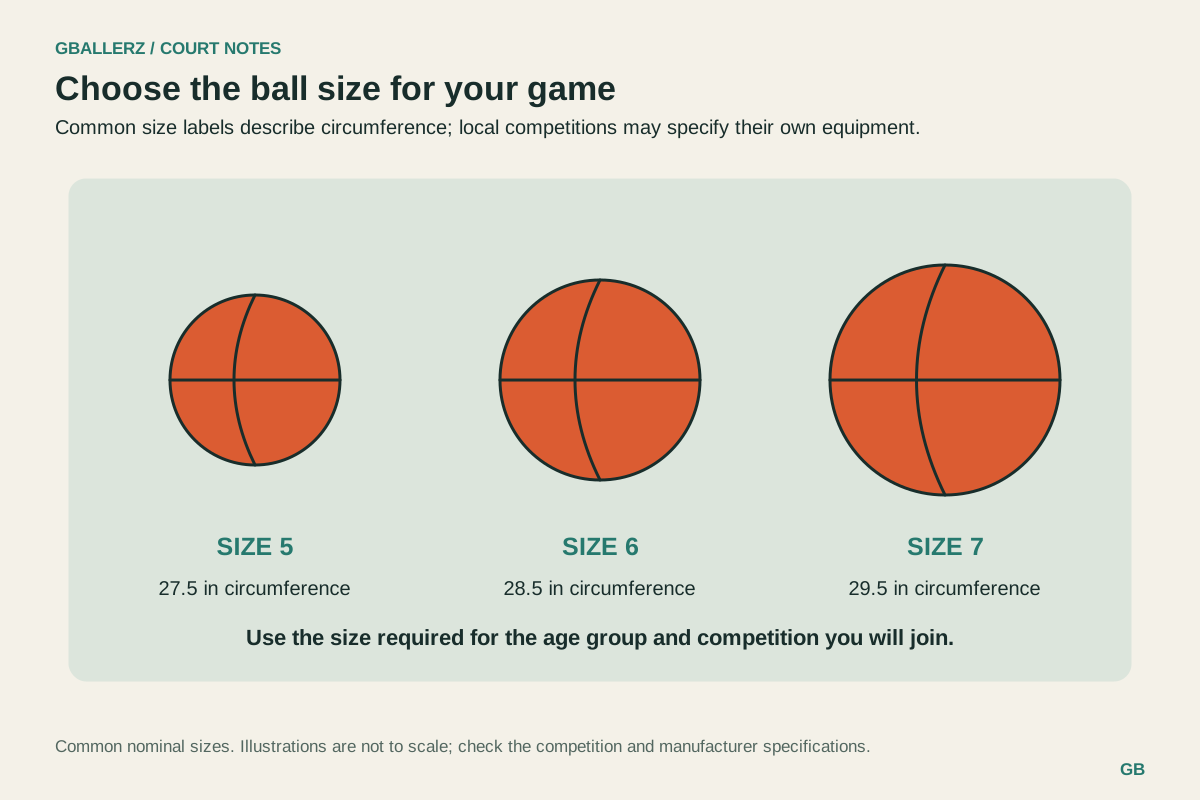
Common full-sized choices include size 7 at about 29.5 inches in circumference and size 6 at about 28.5 inches. Size 5 is commonly around 27.5 inches. These are circumference measurements, not the diameter across the ball. Check the product specification because youth and specialty models can differ.
A men's professional game ball is not the default answer for every player. The label identifies one intended setting. A smaller ball may be the correct equipment for a youth division or women's competition rather than a temporary substitute for something more legitimate.
For a league or school team, find the ball size and any approved-model requirements in the competition information. If the wording is unclear, ask the organizer before buying. Age-group names alone can be misleading because local programs do not all use identical cutoffs.
Practice with the specified ball when preparing for that competition. Borrowing the team's ball for a few supervised repetitions can help you compare size and feel before purchasing your own. Confirm the specification directly instead of relying on a shop assistant's guess about your division.
Use youth guidance as guidance
USA Basketball's youth recommendations use size 5 for ages seven to eight, size 6 for ages nine to eleven, and size 6 for girls or size 7 for boys in the twelve-to-fourteen segment. These are published developmental recommendations; the actual local program may apply its own equipment rules.
For informal learning, pay attention to whether the player can control the ball and practice a comfortable motion at an appropriate distance. Do not use repeated long heaves as proof that a child needs to work harder with an adult-sized ball. Adjust the task and equipment together.
Check specialty formats separately
Three-on-three at a park does not automatically require the official ball used in organized FIBA 3x3. Formal formats can specify a particular circumference and weight combination. Look up the event's requirement rather than assuming the familiar size number tells you everything.
A mini ball can be enjoyable for a small hoop or casual game, but it is not interchangeable with a competition practice ball. If buying a gift, ask what game the recipient actually plays. That question is more useful than selecting the largest option in the store.
Keep the purchase focused
Once you know the required size, compare the intended surface and budget. Do not upgrade to an indoor-only cover if the ball will spend its time on rough pavement. The correct size and suitable surface rating matter before branding details.
For a shared household, one ball may not fit every person's league. Label different sizes clearly so they do not get mixed up before a session. Recheck requirements when a player moves divisions rather than assuming the ball purchased several seasons ago will remain correct indefinitely.
Verify the game's specification, read the circumference correctly and choose a surface-appropriate ball in that size.
Further reference
Something unclear? Send a correction or question.