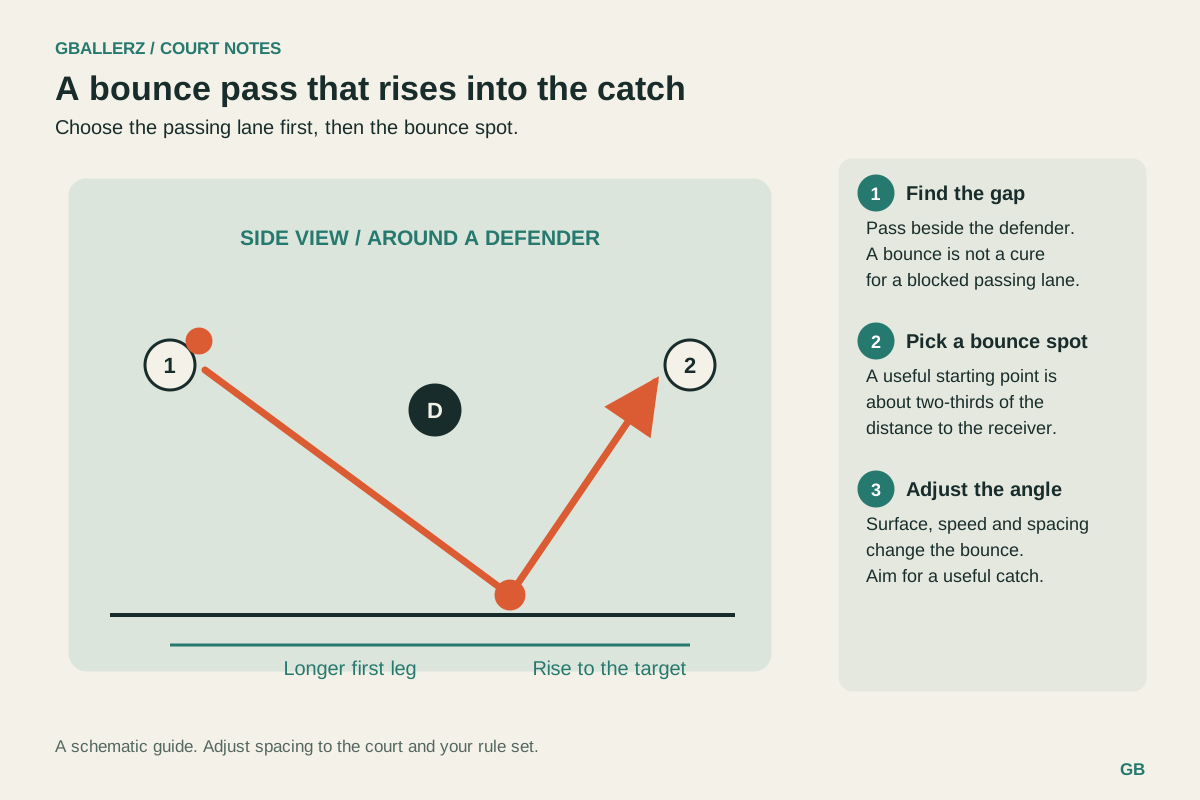
A bounce pass can travel beneath an outstretched arm or reach a teammate through a low opening. It is useful only when the floor route and the space after the bounce are clear. Sending the ball downward does not automatically make a crowded pass safe. You need to judge the angle, the floor and the receiver's movement, then give the ball enough pace to rise into a catchable window.
Find the bounce point by testing
Begin with a stationary partner at a comfortable distance. Aim the bounce so the ball rises toward their hands without making them crouch or reach. A point somewhat nearer the receiver than yourself is a useful starting experiment, but the best location changes with distance, force and the ball's bounce. Do not memorize one floor mark for every pass. Make several attempts, ask where the catch arrived and shift the bounce point slightly. You are learning a relationship between the flight before and after the floor contact.
Use the defender's hands as information
Add a partner standing between passer and receiver with hands up, leaving a visible low lane. Bounce through that lane with control. Then have the defender lower their hands or shade a foot toward the route. Recognize when the same pass becomes unavailable. A low delivery that travels near the defender's feet can be intercepted even when their hands started high. Practice choosing another angle or keeping the ball. A good decision includes refusing a bounce pass when its original reason has disappeared.
Account for the playing surface
On a clean, even floor, the bounce may be predictable. Outdoor cracks, damp patches or loose debris can change the path. Inspect the route before using a floor target in practice, and relocate if the surface is unsuitable. Do not use extra force to compensate for an unreliable patch. Test a few controlled passes after moving to a different court or changing balls. The receiver should not need to guess whether the bounce will die near their shoes or jump toward their face. Surface awareness is part of passing accuracy.
Time the pass to the receiver's space
Have the receiver take a short cut into an open area while you choose the bounce point ahead of their path. Start slowly with a wide lane and increase pace only when they can catch without breaking stride. If the ball lands behind them, release earlier or adjust the target forward, changing one factor at a time. Finally, add a passive defender and decide whether the opening lasts long enough. The bounce adds travel time; a gap that looks open at release may be occupied before the ball rises toward the receiver.
Practice stationary and moving bounce passes separately, then add a defender who changes hand position so you must decide when the low route remains useful.
Something unclear? Send a correction or question.