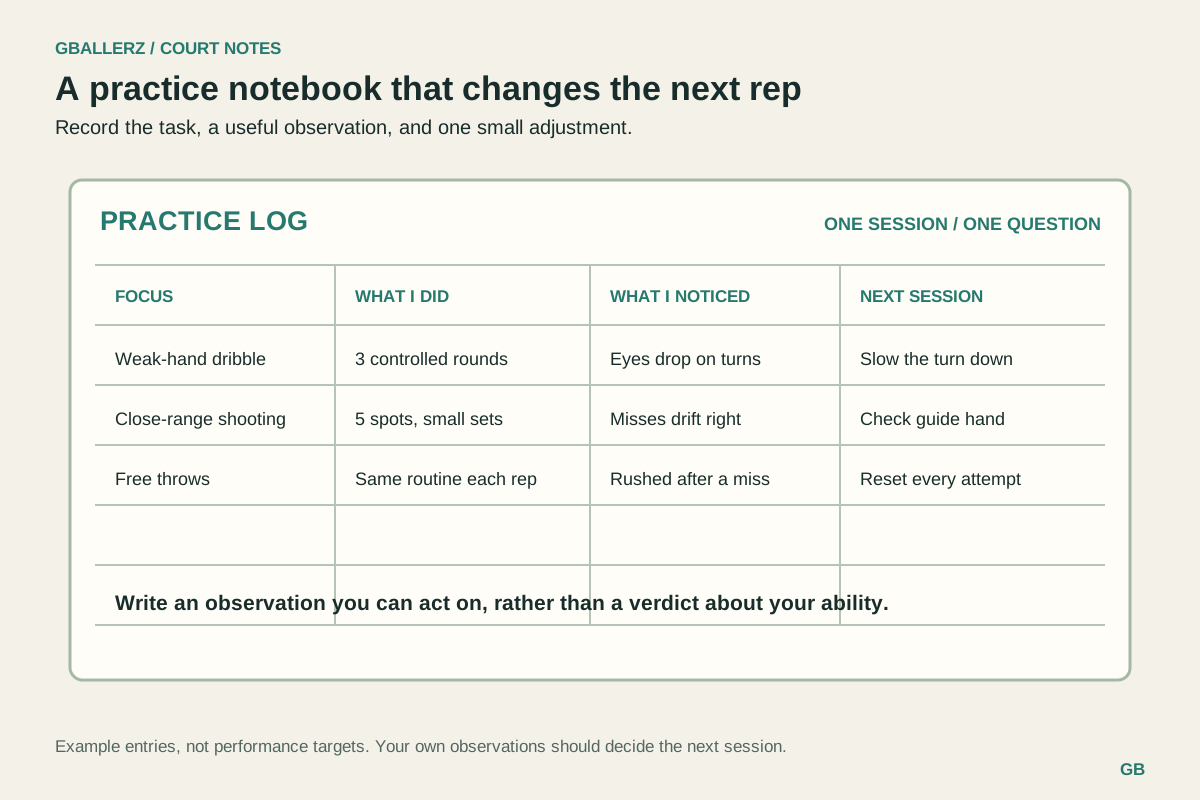
A useful practice notebook answers a small question: what should you repeat or adjust next time? A list of made shots can help, but it leaves out the distance, preparation and conditions that made those shots comparable. Keep the record brief and concrete. A few consistent notes written after practice are more valuable than an elaborate tracking system you abandon after two sessions.
Describe the task, not just the score
Write the date, the skill and the setup in one line. For shooting, include the location and whether the attempt began from a catch or a dribble. For handling, note the hand, route and pace. A record such as seven clean left-hand trips from wing to outlet out of ten tells you what happened and what to repeat. A bare number like seventy percent cannot explain whether the next practice should use the same challenge, a slower pace or a different distance.
Choose a definition of success
Before counting, decide what qualifies as a useful repetition. You might require a catch in stride, a balanced finish or a dribble route completed without switching hands. Keep makes separate when the skill includes more than scoring. If your definition changes halfway through the set, mark that clearly and begin a fresh count. Consistency makes comparisons meaningful. The aim is not to produce flattering numbers but to notice whether the actual task is becoming more reliable under similar conditions.
Capture one pattern in ordinary language
After the session, write the most repeated difficulty without trying to explain everything. Examples include passes arriving behind a leftward cut, a pull-up drifting forward or a retreat ending too close to the sideline. Distinguish what you observed from what you suspect caused it. You can write that the last step became long, then propose testing a shorter approach. This protects you from treating a guess as a fact and rebuilding a skill around an explanation you have never checked.
Set the next test while it is fresh
Choose one practical adjustment for the next session and state how you will compare it. If weak-hand control fell apart at jogging pace, repeat the same route at a walk before returning to the faster set. If catches pulled you backward, try an earlier release with the same passing distance. Keep the test narrow enough to finish within a short block. A notebook should lead to an action you can perform, rather than an expanding list of vague intentions to improve everything.
Review trends without chasing every fluctuation
Look back across several comparable sessions before deciding a single poor day is a major problem. Note unusual conditions such as a different ball, an uneven surface or a shortened session. You do not need personal or medical information. When the same issue persists, bring the task description and a short permitted video to a coach for focused feedback.
Use four short entries after practice: the setup, the result, one observed pattern and one adjustment to test during the next comparable set.
Something unclear? Send a correction or question.