With fewer players, a half-court game can make every cut, screen and missed rotation easy to see. It can also become cramped when all three teammates want the ball near the same spot. Keep a simple relationship between the ball handler, one immediate partner and a third player who preserves another window.
Set the local format first
Before playing, confirm scoring, possession after baskets, clearing requirements and how dead balls restart. A casual three-on-three run may use its own house rules. Official FIBA 3x3 is a distinct competition format, so the number of players alone does not tell you which procedures apply.
If your group intends to use official rules, consult the current published rules rather than assembling fragments from different runs. If you use local adaptations, name them clearly. Everyone should know whether a rebound needs clearing before someone attempts a quick put-back.
Start in three different windows
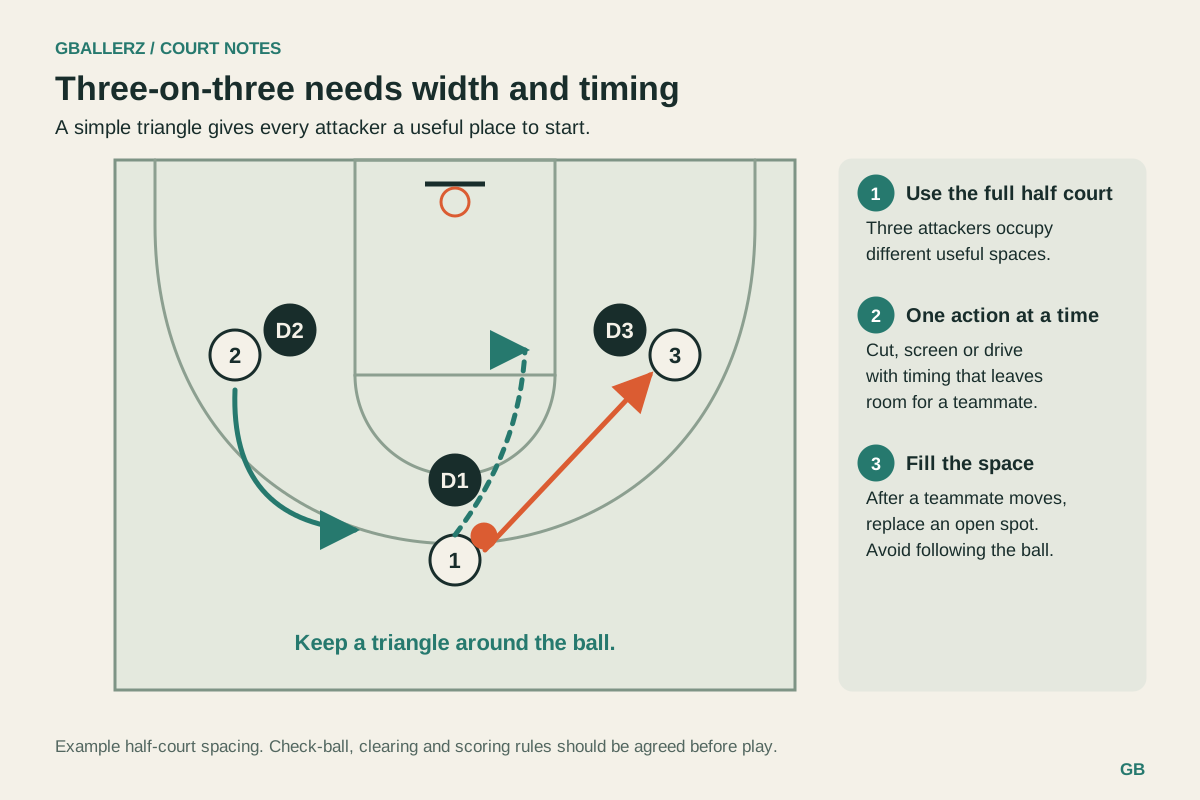
A simple starting shape might place the ball at the top, one teammate on a wing and another toward the opposite side. It gives the handler a visible option in each direction. The exact spots matter less than avoiding two teammates hidden behind the same defender.
Keep your positions within usable range. If neither off-ball player can threaten from the perimeter, consider a cut and replacement rather than parking both beside the rim. You need movement that creates a choice, not distance that the defense can ignore.
Pair an action with a response
After passing to the wing, you might cut while the third player replaces the space you left. Alternatively, you might screen for the third player while the receiver watches the opening. Choose one clear action rather than having both off-ball players rush toward the new ball handler.
When a screen starts, the third player should keep their defender away from the rolling route. Watch for a help commitment that creates your own catch. This makes the third person part of the action instead of a spectator waiting for a turn.
Move the advantage quickly
Three defenders can recover when the offense stops to admire a successful first move. Catch ready to decide whether to shoot, drive or pass. The next pass may be the one that produces the open finish.
Avoid a rigid rule that every player must touch the ball before a shot. It can encourage unnecessary passes after a good chance already exists. Share involvement over the run by creating useful options, while still taking clear opportunities that the team earns.
Finish with responsibilities on defense
After the possession changes, identify your player and communicate any temporary exchange. With only three defenders, one forgotten matchup leaves a large gap. Do not remain near the basket debating the last shot while an opponent prepares to attack.
For practice, play short games with a focus such as cutting after a pass or communicating screens. Review one example between games, then play again without stopping every possession. Three-on-three is especially useful when the group learns from clear, repeated situations while keeping the game flowing.
Keep three distinct options, pair each action with useful spacing and agree on the format before the first possession.
Further reference
Something unclear? Send a correction or question.