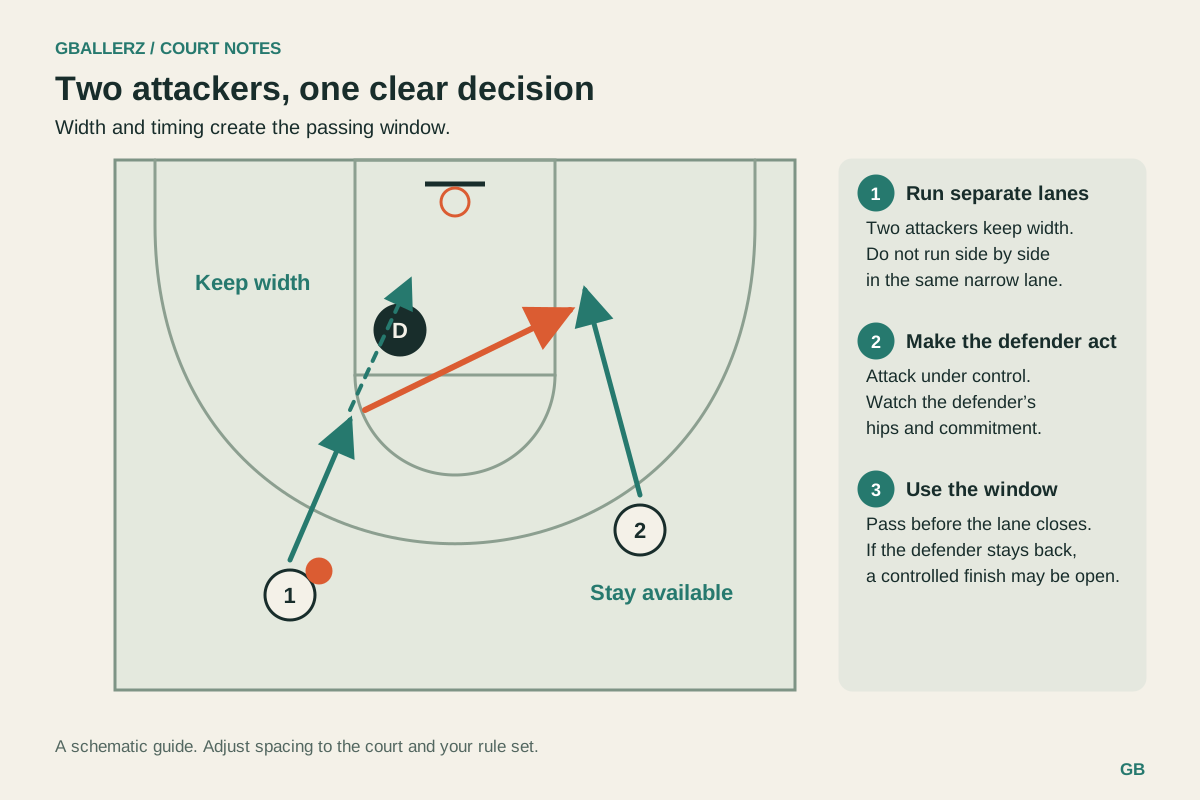
Two attackers and one defender should offer a useful advantage, but the play often fails because both attackers run toward the same side of the rim. The defender then controls the entire finish area. Make the court feel wide, stay connected and decide while there is still room to deliver a simple pass.
Run separate lanes
The ball handler and teammate should advance with enough width that one defender cannot comfortably reach both. The runner should stay visible rather than sprinting directly behind the handler. Adjust to the court and available space instead of tracing a rigid diagram.
Avoid drifting so wide that the eventual pass becomes a long throw across the defender's reach. The aim is useful separation and a reachable finish, not maximum distance. As you approach the basket, preserve the passing angle while staying out of each other's path.
Attack the defender's decision
The handler should move toward a route from which a controlled finish is possible. If you remain far from the basket waiting to pass, the defender has little reason to leave the runner. Make your scoring option real enough that they must respond.
Keep your head up and watch the defender's chest and movement. If they step firmly toward you, the runner may become available. If they remain between you and the runner, a controlled finish could be the better choice. Do not pass merely because two-on-one drills are associated with passing.
Deliver before the gap disappears
A pass made after the defender is already at your body can become a desperate wraparound attempt. Read early enough to send the ball through a clear window. A bounce pass may fit beneath an arm, while a direct pass may be simpler when the defender has fully committed.
Lead the runner only into space they can reach safely. Throwing the ball too far under the rim leaves a difficult catch with little finishing angle. Give them a chance to catch, organize and finish without crossing through the defender.
The runner must stay ready
Maintain a speed that keeps you connected to the ball. Racing well ahead can place you under the basket before the handler reaches the decision point. Slowing too much lets a trailing defender erase the advantage.
Show your hands and watch the ball while checking your route. If the handler shoots, pursue a possible rebound without crowding their landing. If you receive the pass, a simple finish usually preserves the advantage better than adding an unnecessary fake for an opponent who is already out of position.
Practice changing the defensive choice
The exercise can eventually include a live defender and then a trailing player with a delayed start. Judge whether the decision was available when it was made, not just whether the shot went in. A missed open finish can still come from a good read; a completed risky pass may still need correction.
- Start with two attackers near midcourt and a defender nearer the basket.
- Have the defender alternate between committing to the handler and staying with the runner.
- Play at a controlled speed, then ask the handler to explain what they saw.
Keep two distinct lanes, make the handler a scoring threat and pass while the receiver still has a clean route.
Something unclear? Send a correction or question.