Counting footsteps from a professional highlight is a poor first lesson in traveling. You also need to know when control begins, what the player is doing and which rulebook applies. Start with a simple stationary catch. It makes the relationship between the ball, the floor and your pivot foot much easier to understand.
Name the rulebook
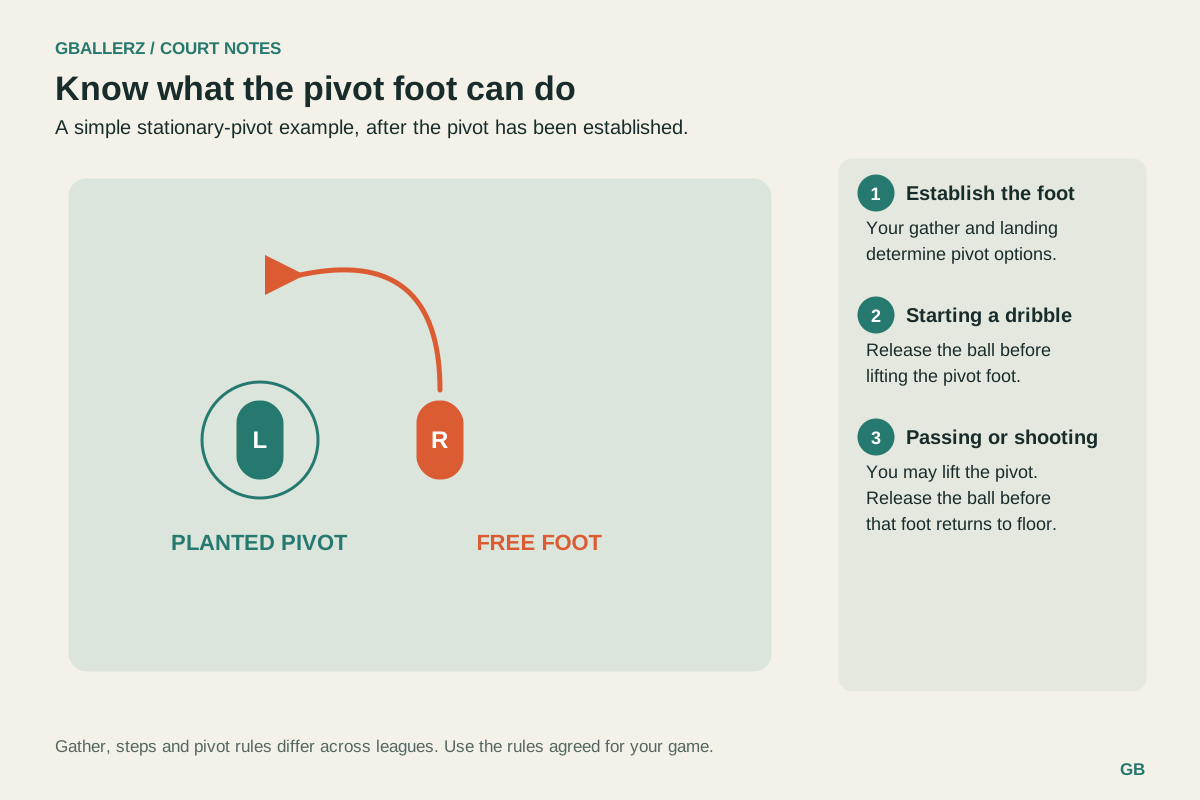
This article uses the NBA stationary-pivot rule as a clearly identified example. NBA Rule No. 4 explains that a player starting a dribble after a pivot must release the ball before lifting the pivot foot. To pass or shoot, the pivot foot may lift, but the ball must be released before that foot returns to the floor.
Your school, recreational league or tournament may use a different code and interpretations. Ask the organizer which rules apply. Avoid arguing that a move must be legal everywhere because an NBA player used something similar on television.
Give the pivot foot a clear identity
Catch the ball while standing still with both feet down. Choose the left foot as your pivot for the drill and move the right foot into a passing stance. Keep the left foot in its original place. Reverse the exercise so the right foot becomes the pivot.
Do not shuffle the planted foot to make the turn easier. Turn through a comfortable range and protect the ball with your body position rather than stretching into an unstable pose. If you lose track of the pivot, stop and begin the repetition again.
Separate starting a dribble from shooting
For the stationary-pivot example, practice dropping the ball to begin your dribble before lifting the pivot foot. A common error is stepping away first and releasing the ball a moment later. Slow the movement until you can see the release happen before the lift.
On a pass or shot, practice releasing the ball before a lifted pivot foot lands again. These two actions have different restrictions. Treating every movement as permission to take two steps is a shortcut that causes confusion rather than solving it.
Study moving catches separately
Moving catches and the end of a dribble require attention to when control or the gather occurs under the applicable code. The NBA describes those situations in Rule No. 10. Learn them with the full wording and examples for your competition instead of importing a generic extra-step explanation.
Film a slow repetition from the side if you have permission and a clear filming area. Identify the instant of control, then the subsequent foot contacts. If that instant is uncertain, a confident step count alone cannot settle the play.
Use a practical partner check
Have a partner watch your pivot foot while you make five stationary passes and five dribble starts. They should report the observable sequence rather than simply saying that the move looks awkward. Change only one detail, such as an earlier ball release, before repeating.
During pickup, establish the expected rule set and handle close calls through the group's agreed procedure. Do not spend several possessions trying to reenact a disputed clip. A reliable, simple move you can execute clearly is more useful than winning an argument about a borderline one.
Establish the pivot, coordinate the release with your feet, and learn moving catches from the rulebook used in your competition.
Further reference
Something unclear? Send a correction or question.