A rebound is not a completed defensive possession if the ball immediately gets stripped or thrown to the other team. The outlet does not need to be spectacular. A controlled catch, a clear receiving angle and one accurate pass can move the ball away from the basket before the defense has time to organize.
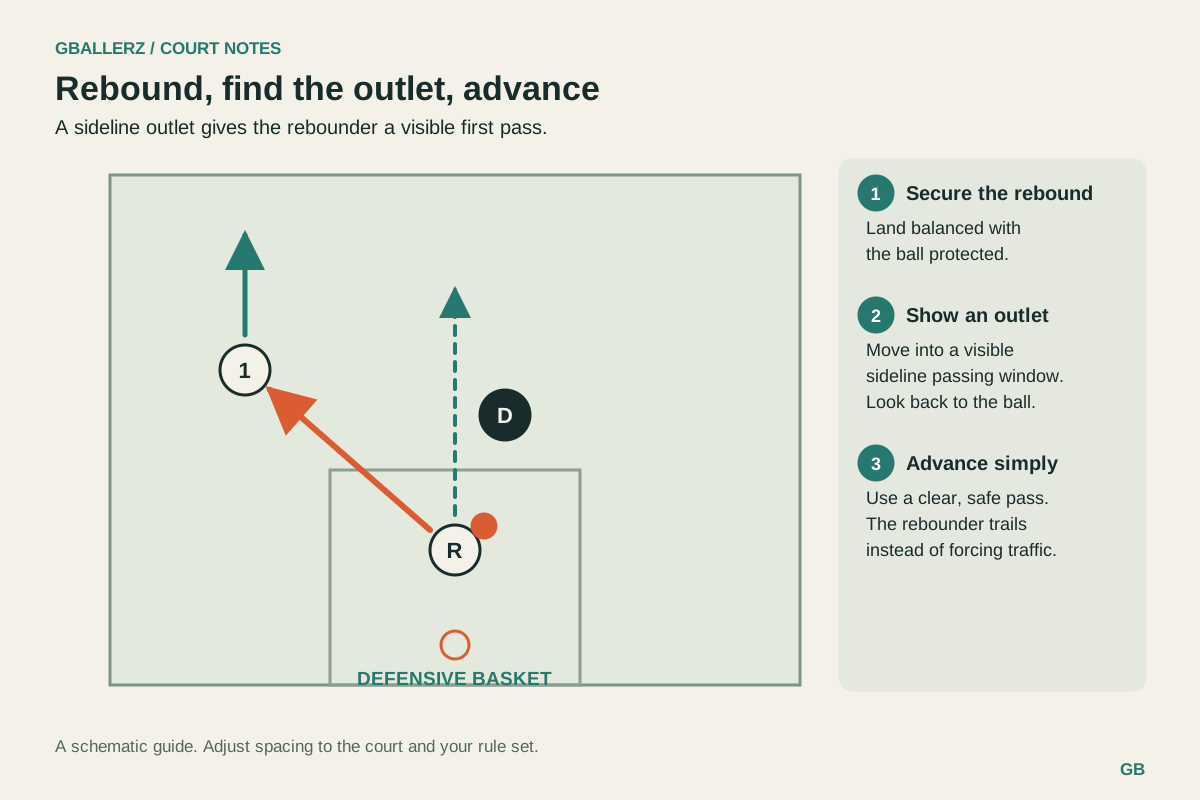
Finish securing the rebound
Bring the ball under control and establish your balance before looking for a long pass. Keep it away from reaching hands without swinging elbows. If you are surrounded, protect the ball and use a legal pivot to see a clearer side of the floor.
Do not assume the first teammate shouting is the best option. Their voice may come from behind a defender. A short, visible pass to a player with room can be more valuable than an ambitious throw toward a runner whose route is already covered.
Give the rebounder an easy angle
The outlet receiver should move outside the immediate rebounding crowd and face the ball. A spot toward the sideline can create an angle, but it should leave room to turn and handle pressure. Standing with a heel near the boundary makes the next action harder.
Avoid hiding directly behind an opponent. Move a few steps until the rebounder can see your hands and the passing lane. Call briefly when you are available, then be ready to catch instead of continuing to run away while the ball is in the air.
Pass to the receiver's next action
An outlet to a stationary receiver should arrive where they can secure it without reaching into traffic. A moving receiver needs the ball led into clear space, with enough margin that it does not carry them out of bounds.
Use a pass appropriate to the distance and defenders. A two-handed pass may be sufficient for a short outlet. An overhead pass can help clear nearby arms, but avoid an exaggerated windup that gives opponents time to anticipate it. The route matters more than the style.
Advance with a view of both sides
After receiving, look upcourt before committing to repeated dribbles. A teammate may already be ahead with a clear route, or the defense may have recovered enough that a controlled advance is better. Catching an outlet is the start of a decision, not an instruction to sprint blindly.
The rebounder should join the play after passing. They can trail as a return option or fill an open lane. Watching the pass from under the basket leaves the offense short of a useful support player if the first advance is stopped.
Rehearse the entire chain
With three players, have one toss the ball off the backboard, another rebound and a third show for the outlet. The outlet receiver turns, looks ahead and passes to the original tosser moving upcourt. Rotate every few repetitions.
Add light pressure only after the passing angles are clear. Count possessions in which the ball gets secured and advanced without a bobble, boundary problem or blind throw. If the sequence breaks down, identify the exact link: rebound control, receiving position, pass placement or the decision after the catch.
Secure, see and pass: a clear short outlet is often the quickest way to turn a rebound into useful offense.
Something unclear? Send a correction or question.