The outsole is the part of a basketball shoe that repeatedly meets the court, yet it is easy to overlook when a colorway or cushioning description attracts your attention. Outdoor surfaces vary from painted smooth courts to rough asphalt. Start with the actual surface you use, then inspect the shoe's intended use and construction.
Look for an explicit outdoor purpose
Read the exact model description and regional version rather than assuming all shoes in a named series share the same outsole. Nike, for example, describes its outdoor-focused S.T. Flare with an XDR outsole and macro herringbone pattern. That is a specific product example, not a guarantee that every shoe with a similar-looking pattern behaves identically.
If a listing does not identify outdoor suitability, ask the manufacturer or retailer. A vague reference to durability may describe the upper rather than the sole. Match the claim to the part of the shoe you are evaluating before treating it as evidence for pavement use.
Inspect coverage and the tread
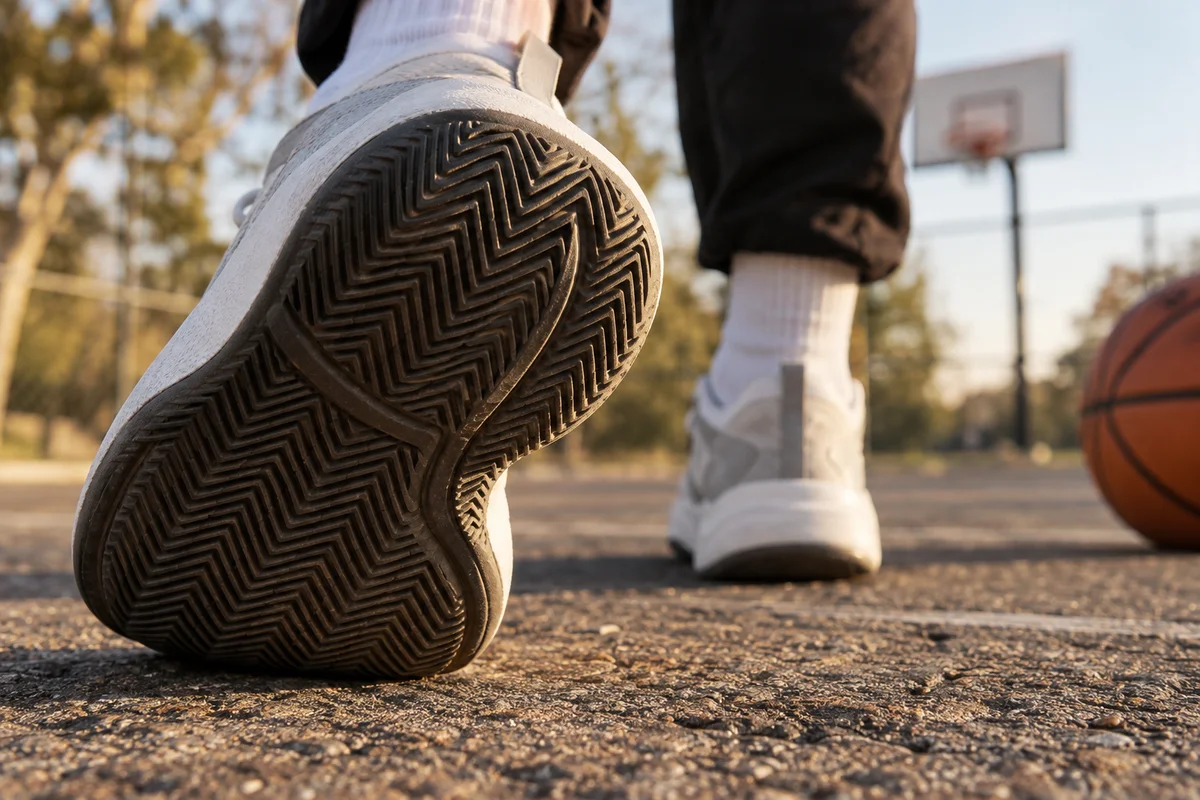
Turn the shoe over and see where rubber actually contacts the ground. Notice any exposed foam in areas that would meet your court during stops or turns. Also inspect the depth and size of the tread features rather than considering the pattern's name alone.
Very fine edges and broad, substantial grooves present different wear questions on abrasive surfaces. Appearance cannot establish a precise lifespan, however. Compare the maker's intended use and, where available, consistent testing of the exact model. Avoid predicting a number of months from a photograph.
Separate grip from wear resistance
A sole can feel grippy during a short clean-floor test without proving how it will wear outdoors. Likewise, a sturdy-looking outsole does not promise excellent traction on every dusty or painted surface. These are related but different questions.
Your local court may contain grit, damp areas or worn paint that changes grip. Inspect conditions before playing and do not use a purchase decision as reassurance that a slippery surface is safe. Even a suitable outdoor shoe still needs a playable court beneath it.
Account for the rest of the shoe
An outsole that suits pavement is only helpful if the shoe also fits and feels stable during your movements. Try the pair with your normal socks, check heel hold and compare controlled lateral steps. Do not sacrifice a workable fit to obtain a particular rubber label.
Consider comfort over the sessions you actually play. A budget model that meets your needs may be sensible, while a costly indoor-focused model may wear differently on your court. Compare complete options rather than paying for a feature list in which the outdoor use case is only assumed.
Watch the wear you already produce
Inspect your current shoes for the areas that wear first. Some players see the forefoot edges fade; others notice heel wear or smooth spots near a pivot area. Use those observations to ask better questions about rubber coverage in the next pair.
Recheck the outsole during ordinary cleaning and compare both shoes. If traction changes or material separates, pause to assess the shoe and court instead of waiting for a calendar-based replacement date. Keep any indoor pair separate if you want to preserve it for gym use, and choose the outdoor pair for the court it will actually face.
Confirm the exact model's outdoor intent, inspect its contact areas and choose a complete shoe that fits your court and your feet.
Further reference
Something unclear? Send a correction or question.